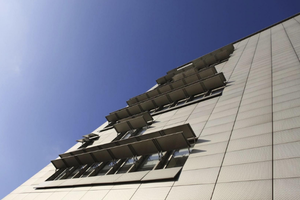
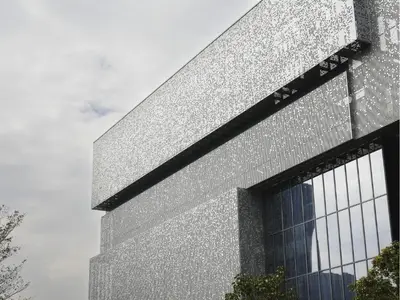
Motorised external blinds, louvers, and façades that automatically track the sun through the day. Dynamic solar shading systems sit outside the glazing or façade and automatically adjust angle or position through the day. Sensors measure sun angle, brightness, and temperature, and motors tilt louvers or move blinds to block direct radiation while allowing daylight.
This reduces solar heat gain before it enters the building, far more effective than internal blinds. Commercial buildings can significantly lower HVAC demand and glare while maintaining views and daylight quality.
Façade performance and energy codes are tightening globally, and dynamic shading offers measurable cooling reduction without sacrificing architectural transparency.
2) Smart Motorised Pergolas
Automated outdoor roofing for terraces and podiums
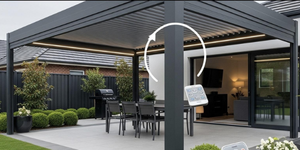
Smart pergolas use motorised louvers or retractable fabric roofs to create adaptable outdoor cover. Louvers rotate to control sunlight and ventilation, or retract fully to open the sky. Rain and wind sensors automatically close the roof for weather protection.
They transform terraces into usable spaces across seasons, crucial for hospitality and premium residential design where outdoor experience is a value driver.
Outdoor space has become commercial real estate ,pergolas convert weather-dependent areas into revenue-generating zones.
3) Retractable Outdoor Screens
Vertical shading that preserves views and airflow
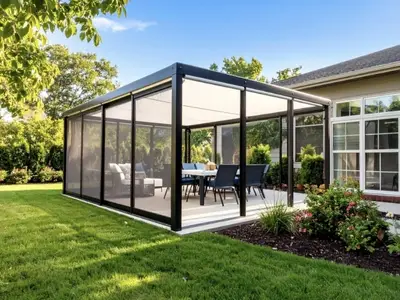
Retractable screens are vertical fabric panels that drop from pergolas, balconies, or roofs. They filter sunlight, block glare, reduce wind, and keep insects out while maintaining outward visibility and ventilation.
Unlike glass enclosures, they preserve an open-air feeling. Fabrics range from transparent mesh to blackout depending on privacy and shading needs.
Design is shifting toward indoor-outdoor continuity. Screens allow climate moderation without closing the space.
4) High-Performance Awnings & Shade Sails
Architectural tensile fabric shading systems
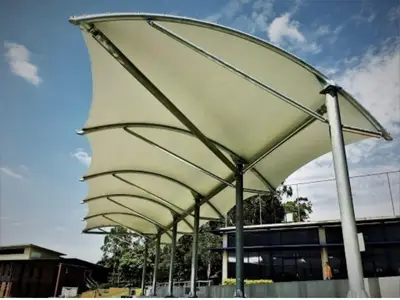
Modern awnings and shade sails use engineered technical fabrics tensioned over frames or cables. These fabrics provide high UV blocking, heat reflection, and weather resistance while remaining lightweight and sculptural.
Large spans can cover plazas or courtyards without heavy structures. Some systems are retractable or sensor-controlled for wind safety.
They deliver large-area shade with minimal structure and strong architectural identity, ideal for open public environments.
5) Energy-Generating Shading (PV)
Shading structures that also produce electricity
PV shading integrates solar panels or photovoltaic glass into shading devices such as pergolas, louvers, canopies, or façades. The same element that blocks sun also generates renewable energy.
Because shading and solar orientation both depend on sun exposure, combining them is highly efficient. Buildings gain cooling reduction and power generation from one structure.